Basically, there are two types of succession; these are
- Primary succession
- Secondary succession
1. Primary Succession
This is a type of succession that begins from bare ground, bare rock or bare body of water.
Primary succession on land may be studied on a building site where a heap of sub-soil, stones or cement block is left over after construction. In an aquatic habitat, primary succession may be observed in a new artificial pond.
The first in any succession are called primary colonizers and are usually autotrophic plants. These have simple requirements for life and can withstand exposures. By the second year of the primary succession in addition to more algae and lichens, mosses may begin to grow. As they grow, they wear out some soil and some of them die and decay, creating more soil for their successor.
By the third year, small herbaceous plants may be present. These in turn help to change the habitat by overshadowing the smaller plants, causing them to die out and dropping their leaves, and thus making the soil suitable for other organisms. As years pass by, more species come into the habitat, while some face out. Succession of species continues till the climax is reached. Then, bigger life forms like shrubs and trees are found growing. 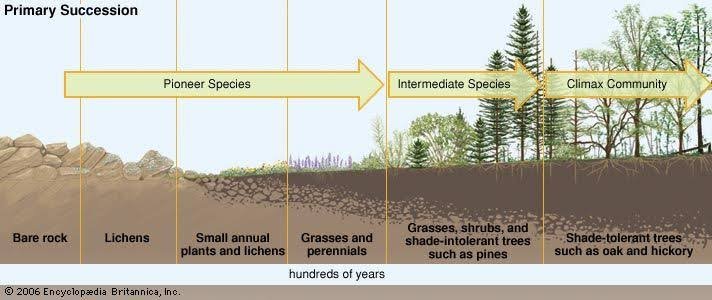
2. Secondary Succession
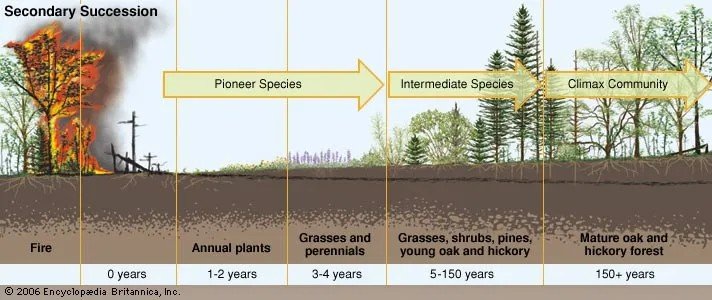
Secondary succession is a succession that occurs when an area has not been totally stripped of soil and vegetation. It occurs more rapidly than primary succession because soil has already been formed. It also occurs when a farmer abandons old field. Secondary succession begins from an existing community which has been interfered with by man and other factors. Fire, drought and floods can cause secondary succession.