The modern Periodic law the properties of the elements are the periodic function of their atomic number.
This means that the chemical properties of elements depend on their atomic number. This can be explained with their electronic configurations.
ELECTRONIC CONFIGURATION AS THE BASIS OF THE PERIODIC TABLE
Electronic configuration is the arrangement of electrons round the nucleus of an atom. The electrons and their arrangement round the nucleus of an atom are responsible for the various properties of elements. The key to the periodicity of elements lies in the electronic configuration of their atoms.
Recall that mass number is the sum of protons and neutrons present in an atom while atomic number is the number of protons present in an atom. The number of protons is equal to the number of electrons in any atom.
The electrons revolve round the nucleus in spherical region called shells or energy levels. Starting from the nearest to the nucleus, the shells are named K, L, M, N, O… These correspond to the energy level numbered 1, 2, 3, 4, 5… The maximum possible number in a given shell is given by the formula 2n2, where n is the energy level number of the shell.
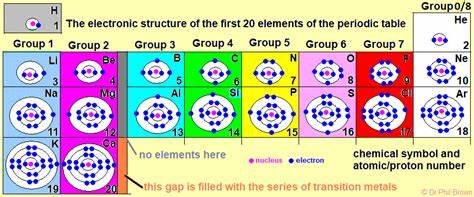
Electronic configuration can also be shown using the sub-shell notation; s, p, d, f. In this case, the maximum number of electron in each sub-shells are 2, 6, 10 and 14 respectively.
| Element | Atomic Number | Electronic configuration |
|---|---|---|
| H | 1 | 1s1 |
| He | 2 | 1s2 |
| Li | 3 | 1s2 2s1 |
| Be | 4 | 1s2 2s2 |
| B | 5 | 1s2 2s2 2p1 |
| C | 6 | 1s2 2s2 2p2 |
| N | 7 | 1s2 2s2 2p3 |
| O | 8 | 1s2 2s2 2p4 |
| F | 9 | 1s2 2s2 2p5 |
| Ne | 10 | 1s2 2s2 2p6 |
| Na | 11 | 1s2 2s2 2p6 3s1 |
| Mg | 12 | 1s2 2s2 2p6 3s2 |
| Al | 13 | 1s2 2s2 2p6 3s2 3p1 |
| Si | 14 | 1s2 2s2 2p6 3s2 3p2 |
| P | 15 | 1s2 2s2 2p6 3s2 3p3 |
| S | 16 | 1s2 2s2 2p6 3s2 3p4 |
| Cl | 17 | 1s2 2s2 2p6 3s2 3p5 |
| Ar | 18 | 1s2 2s2 2p6 3s2 3p6 |
| K | 19 | 1s2 2s2 2p6 3s23p6 4s1 |
| Ca | 20 | 1s2 2s2 2p6 3s23p6 4s2 |